**What**

When a discount is deleted from a cart, the line item adjustments must be refreshed. Now, the cart service `removeDiscount` includes updating the adjustments.

**Tests**

**Add a new integration test which:**
- create a cart with a discount
- add a line item
- validate the adjustments
- remove the discount
- check that the adjustments are not present anymore

**Update unit tests**
The actual tests cases now check that the adjustments repository is called when needed

FIXES CORE-890
### What
Leverage yarn workspaces and Turborepo for integration-tests in order to accelerate development and reduce DevX complexity.

### Why
The current solution for running integration tests requires using `medusa-dev-cli` in order to publish packages to a local npm repository. The package where the command is executed will have its package.json altered for any known medusa dependency in order to install from the local npm. The process is taxing on the host machine resources and prevents rapid iterations when working with integration tests.

For more information, see documentation: f0cc1b324c/docs/content/usage/local-development.md (run-api-integration-tests)

### How
By declaring `integeration-tests/**/*` as a workspace, Turborepo can now be leveraged to build and run integration test as if there were packages. The build process will take care of interdependency between package in order to ensure local dependency are met.

In addition, within each integration-tests "packages", we can declare local dependencies as "*" which will translate to using the one that is part of the current build, regardless of the dependency's version number. No more fiddling with version numbers.

Github actions pertaining to integration-tests have been streamlined to use the new behavior.

The integration-tests packages have been marked as `private:true` in order to avoid publishing them to the public npm registry.

### Testing
```
cd root-of-medusajs-medusa-repo/
yarn install
yarn build
yarn test:integration:api
yarn test:integration:plugins
```

After a code change, `yarn build` must be run before re-running an integration test, which is the same procedure as for unit tests.

Resolves: CORE-845
A discount should always be associated to atleast 1 region - we validate it against the region in the cart service.

Adding a request parameter validation to pass in atleast one regionID in an array of regions will ensure that regionID will be validated as a part of the discount service and fail if its not a valid region ID.
**What**

I have created a new method on the cart service which is `addLineItems`, allowing a user to add one or multiple items in an optimized way. Also updated the `generate` method from the line item service which now also accept a object data or a collection of data which. Various places have been optimized and cache support has been added to the price selection strategy.

The overall optimization allows to reach another 9000% improvement in the response time as a median (Creating a cart with 6 items):

|   | Min (ms)  | Median (ms)  | Max (ms)  | Median Improvement (%)
|---|:-:|---|---|---|
| Before optimisation  | 1200  | 9999 | 12698  |  N/A
| After optimisation | 63  | 252  | 500  | 39x
| After re optimisation | 56 | 82  | 399  | 121x
| After including addressed feedback | 65 | 202  | 495  | 49x

FIXES CORE-722
**What**
-  add/ remove sales channels to/from PublishableApiKey in batch
- associate created cart with SC defined by PK
- filter products if PK with SC association is present
- retrieve a list of sales channels for a PK
- implement 3 new middleware
  - `extendRequestParams`
    -  _extend req object with PK scopes (a list of sales channels) if a publishable key is present in the header of the request_
  - `validateProductSalesChannelAssociation`
    -  _validate if the passed product id belongs to a SC from the PK's scope_
  - `validateSalesChannelParam`
    -  _validate that passed SC ids in the req body/query are within the scope of the PK_

**How**
- The general idea was to reuse existing logic in the controller layer which expects `sales_channel_id` array to be passed. The middleware sets associated SC ids in the request context if a PK is present. These ids are then merged in the controller and passed to the service layer.

**TODO**
- filter response from the search endpoint (CORE-824)

**Testing**
- _integration tests_
  - add sales channels to the publishable API key scope
  - remove sales channels from the publishable API key scope
  - returns products from a specific channel associated with a publishable key
  - returns products from multiples sales channels associated with a publishable key
  - returns all products if PK is not passed
  - returns all products if passed PK doesn't have associated channels
  - should assign sales channel to order on cart completion if PK is present in the header
  - list sales channels from the publishable api key
  -  throws because sales channel in query/body is not in the scope of passed PK

---

**Discussion**
- what about the other endpoints (e.g. GET /store/product/:id - do we return 404 if the product is not in the SC associated with passed PK)
- what about products search route
- what about `/admin/products` & `/admin/orders` routes (do we add the middleware there as well)

---

RESOLVES CORE-792
RESOLVES CORE-793
RESOLVES CORE-816
### What
OAS: Explicitly declare type:object on schemas with properties.
### Why
While not officially required, schemas with properties should have their type explicitly declared as "object". Omitting the type translates to type: any with properties XYZ. The ambiguity can lead to issues when using code generators.
### How
Multiple regex searches to identify schemas missing type: object. Manually edit each schema. Spot check generated OAS.
### Testing
- Ran OAS validator.
- Ran docs build script
### Proof
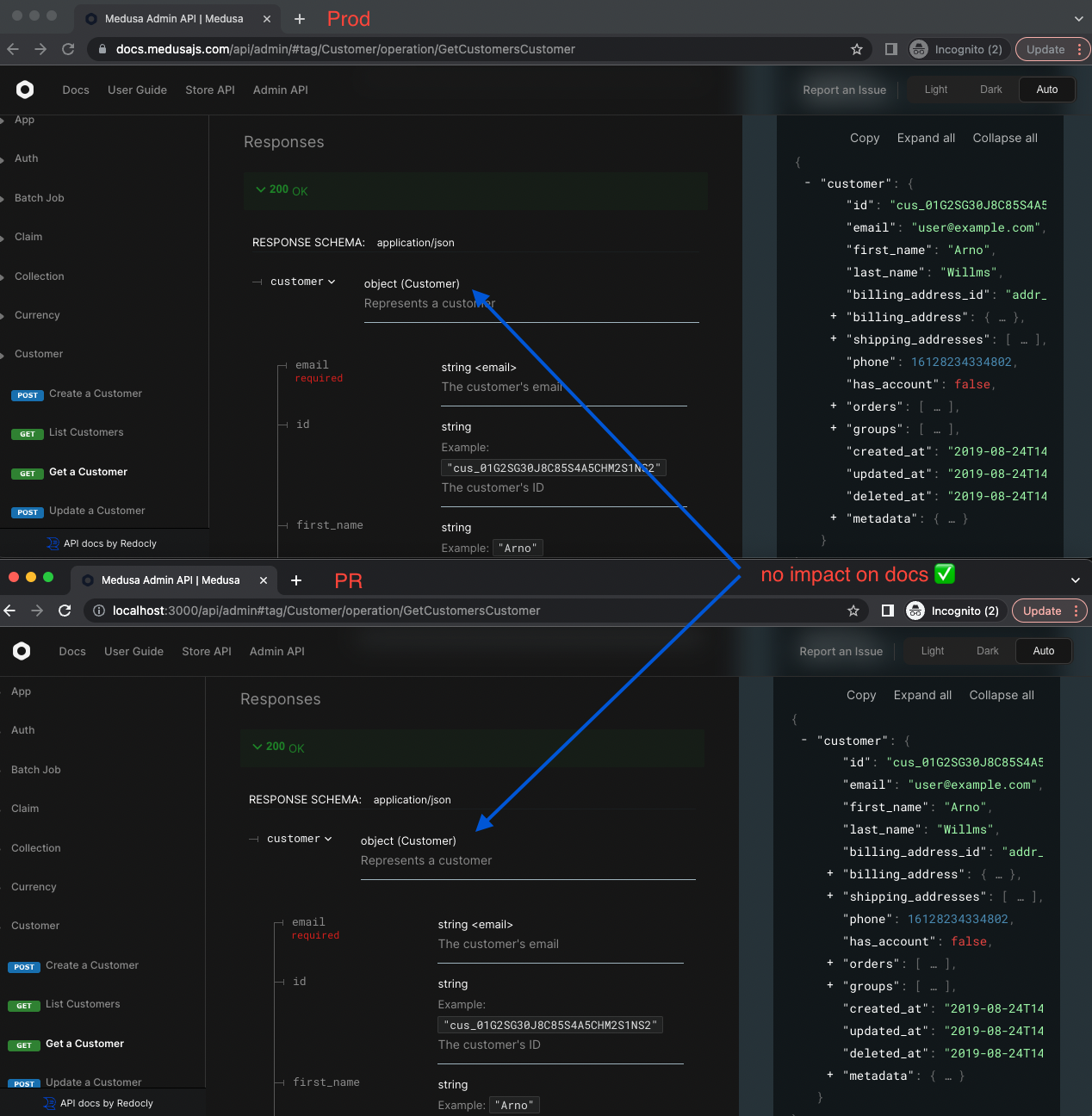
RESOLVES CORE-847
**What**

Allow DraftOrders to be created with an IdempotencyKey.

Note this doesn't implement idempotency for the DraftOrder create endpoint but allows the service layer to ingest the key and store it in the database. This is a preliminary step to being able to support an idempotent API request.


