---
sidebar_label: "Authentication Flows"
---
export const metadata = {
title: `Authentication Flows with the Auth Main Service`,
}
# {metadata.title}
In this document, you'll learn how to use the Auth Module's main service's methods to implement authentication flows and reset a user's password.
## Authentication Methods
### Register
The [register method of the Auth Module's main service](/references/auth/register) creates an auth identity that can be authenticated later.
For example:
```ts
const data = await authModuleService.register(
"emailpass",
// passed to auth provider
{
// ...
}
)
```
This method calls the `register` method of the provider specified in the first parameter and returns its data.
### Authenticate
To authenticate a user, you use the [authenticate method of the Auth Module's main service](/references/auth/authenticate). For example:
```ts
const data = await authModuleService.authenticate(
"emailpass",
// passed to auth provider
{
// ...
}
)
```
This method calls the `authenticate` method of the provider specified in the first parameter and returns its data.
---
## Auth Flow 1: Basic Authentication
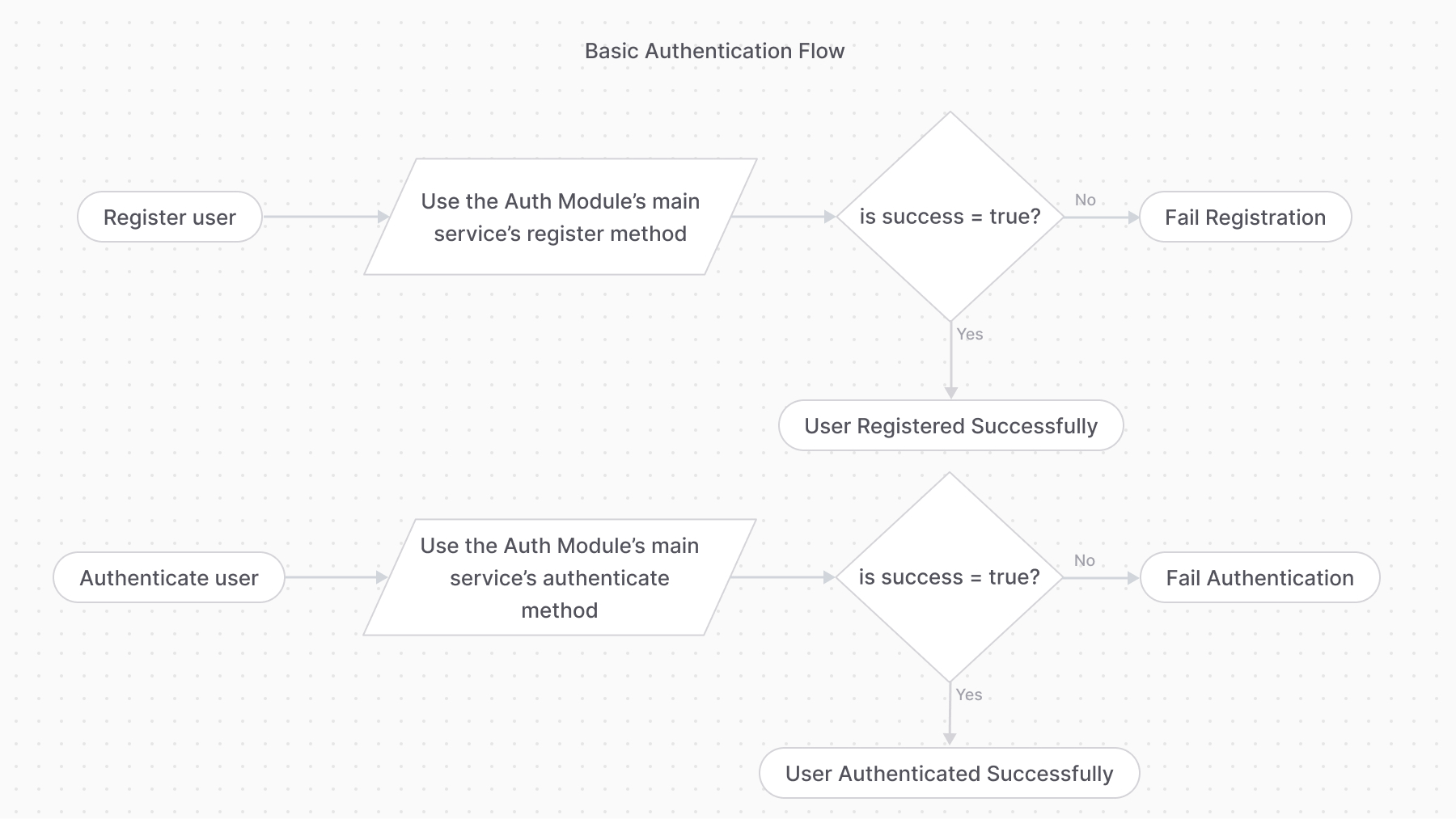
The basic authentication flow requires first using the `register` method, then the `authenticate` method:
```ts
const { success, authIdentity, error } = await authModuleService.register(
"emailpass",
// passed to auth provider
{
// ...
}
)
if (error) {
// registration failed
// TODO return an error
return
}
// later (can be another route for log-in)
const { success, authIdentity, location } = await authModuleService.authenticate(
"emailpass",
// passed to auth provider
{
// ...
}
)
if (success && !location) {
// user is authenticated
}
```
If `success` is true and `location` isn't set, the user is authenticated successfully, and their authentication details are available within the `authIdentity` object.
The next section explains the flow if `location` is set.
Check out the [AuthIdentity](/references/auth/models/AuthIdentity) reference for the received properties in `authIdentity`.
### Auth Identity with Same Identifier
If an auth identity, such as a `customer`, tries to register with an email of another auth identity, the `register` method returns an error. This can happen either if another customer is using the same email, or an admin user has the same email.
There are two ways to handle this:
- Consider the customer authenticated if the `authenticate` method validates that the email and password are correct. This allows admin users, for example, to authenticate as customers.
- Return an error message to the customer, informing them that the email is already in use.
---
## Auth Flow 2: Third-Party Service Authentication
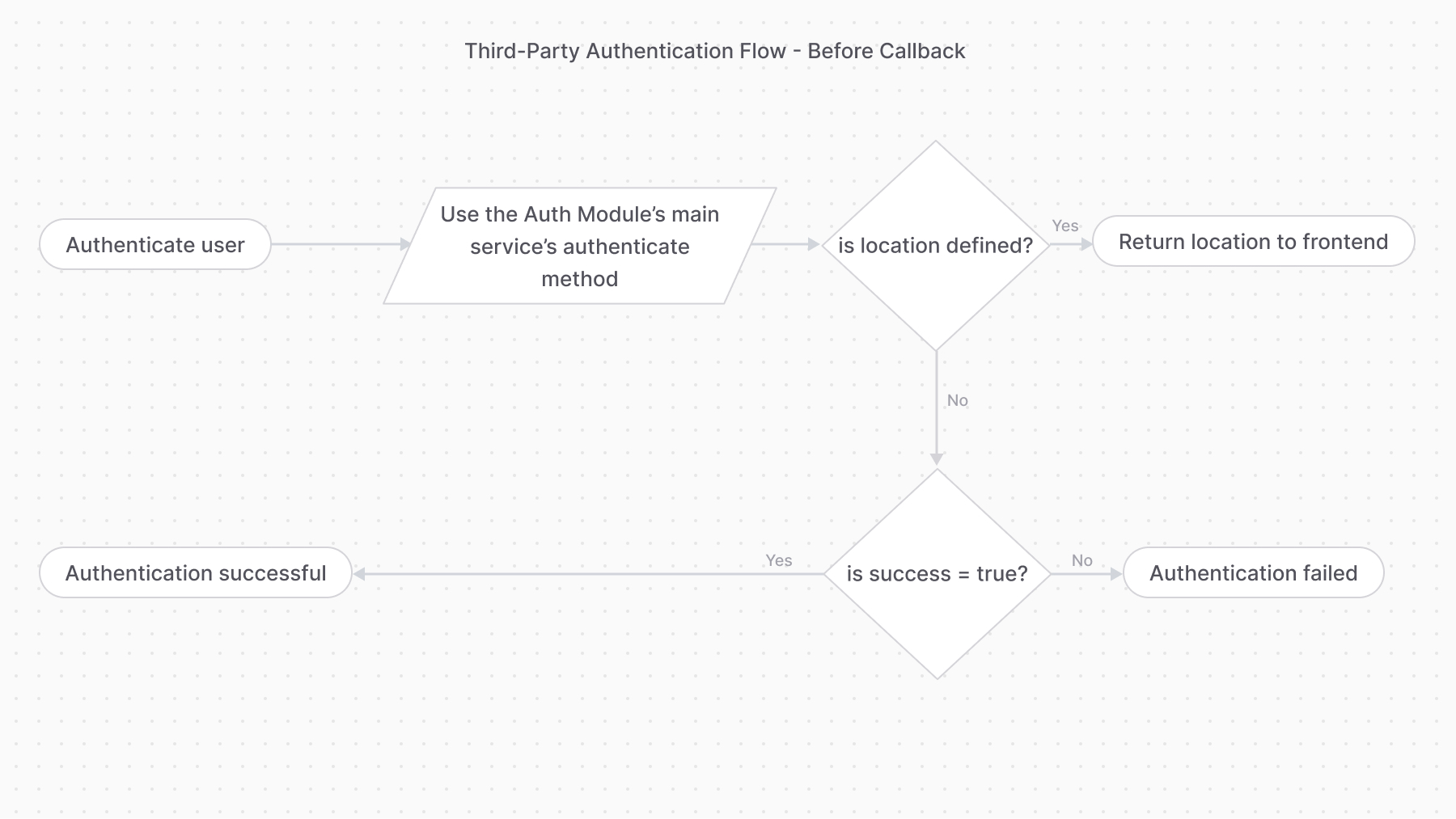
The third-party service authentication method requires using the `authenticate` method first:
```ts
const { success, authIdentity, location } = await authModuleService.authenticate(
"google",
// passed to auth provider
{
// ...
}
)
if (location) {
// return the location for the front-end to redirect to
}
if (!success) {
// authentication failed
}
// authentication successful
```
If the `authenticate` method returns a `location` property, the authentication process requires the user to perform an action with a third-party service. So, you return the `location` to the front-end or client to redirect to that URL.
For example, when using the `google` provider, the `location` is the URL that the user is navigated to login.
### Overriding Callback URL
The Google and GitHub providers allow you to override their `callbackUrl` option during authentication. This is useful when you redirect the user after authentication to a URL based on its actor type. For example, you redirect admin users and customers to different pages.
```ts
const { success, authIdentity, location } = await authModuleService.authenticate(
"google",
// passed to auth provider
{
// ...
callback_url: "example.com",
}
)
```
### validateCallback
Providers handling this authentication flow must implement the `validateCallback` method. It implements the logic to validate the authentication with the third-party service.
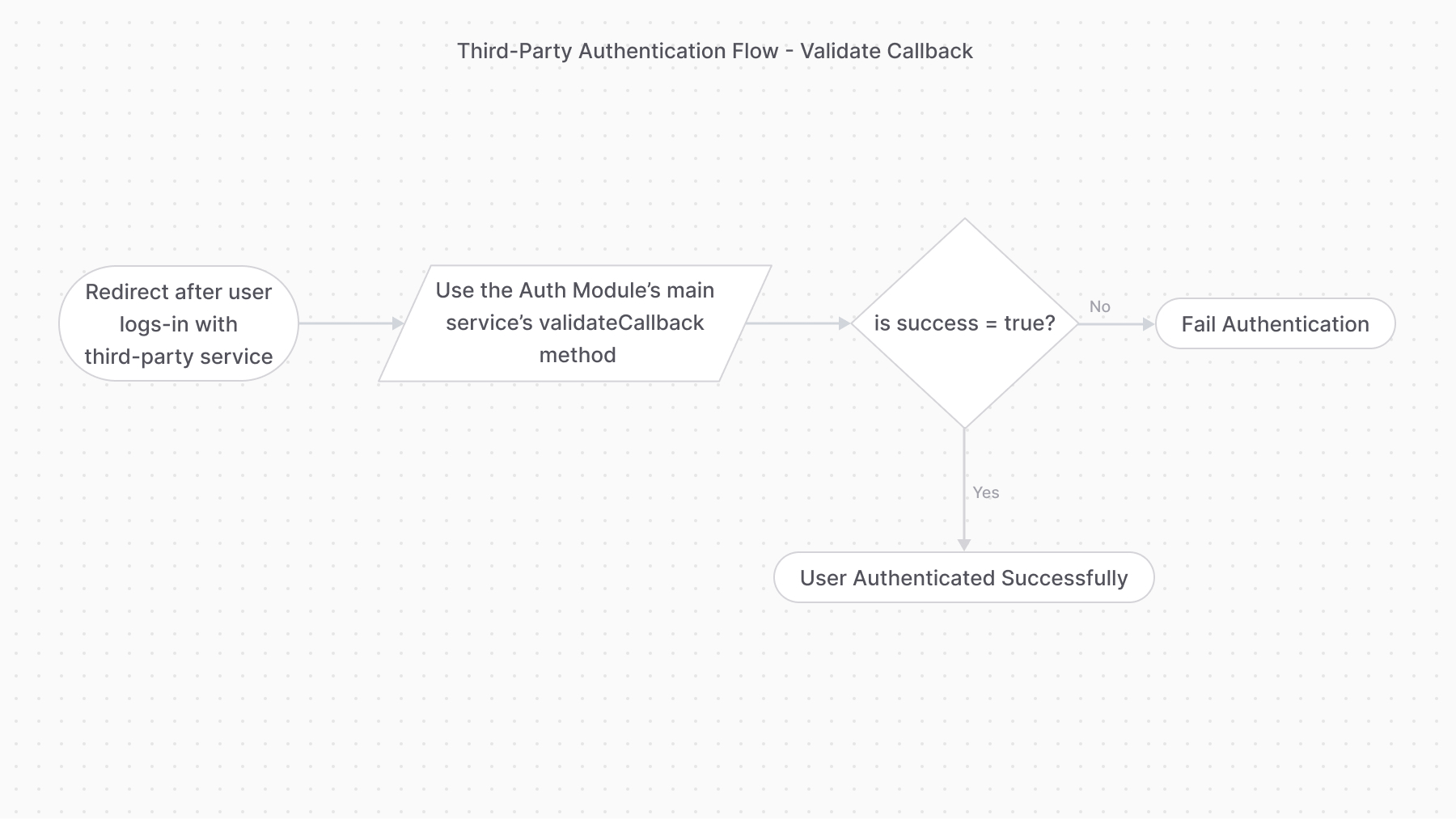
So, once the user performs the required action with the third-party service (for example, log-in with Google), the frontend must redirect to an API route that uses the [validateCallback method of the Auth Module's main service](/references/auth/validateCallback).
The method calls the specified provider’s `validateCallback` method passing it the authentication details it received in the second parameter:
```ts
const { success, authIdentity } = await authModuleService.validateCallback(
"google",
// passed to auth provider
{
// request data, such as
url,
headers,
query,
body,
protocol,
}
)
if (success) {
// authentication succeeded
}
```
For providers like Google, the `query` object contains the query parameters from the original callback URL, such as the `code` and `state` parameters.
If the returned `success` property is `true`, the authentication with the third-party provider was successful.
---
## Reset Password
To update a user's password or other authentication details, use the `updateProvider` method of the Auth Module's main service. It calls the `update` method of the specified authentication provider.
For example:
```ts
const { success } = await authModuleService.updateProvider(
"emailpass",
// passed to the auth provider
{
entity_id: "user@example.com",
password: "supersecret",
}
)
if (success) {
// password reset successfully
}
```
The method accepts as a first parameter the ID of the provider, and as a second parameter the data necessary to reset the password.
In the example above, you use the `emailpass` provider, so you have to pass an object having an `email` and `password` properties.
If the returned `success` property is `true`, the password has reset successfully.