
55 lines
2.4 KiB
Plaintext
55 lines
2.4 KiB
Plaintext
export const metadata = {
|
||
title: `Fulfillment Concepts`,
|
||
}
|
||
|
||
# {metadata.title}
|
||
|
||
In this document, you’ll learn about some basic fulfillment concepts.
|
||
|
||
## Fulfillment Set
|
||
|
||
A fulfillment set is a general form or way of fulfillment. For example, shipping is a form of fulfillment, and pick-up is another form of fulfillment. Each of these can be created as fulfillment sets.
|
||
|
||
A fulfillment set is represented by the [FulfillmentSet data model](/references/fulfillment/models/FulfillmentSet). All other configurations, options, and management features are related to a fulfillment set, in one way or another.
|
||
|
||
```ts
|
||
const fulfillmentSets = await fulfillmentModuleService.createFulfillmentSets(
|
||
[
|
||
{
|
||
name: "Shipping",
|
||
type: "shipping",
|
||
},
|
||
{
|
||
name: "Pick-up",
|
||
type: "pick-up",
|
||
},
|
||
]
|
||
)
|
||
```
|
||
|
||
---
|
||
|
||
## Service Zone
|
||
|
||
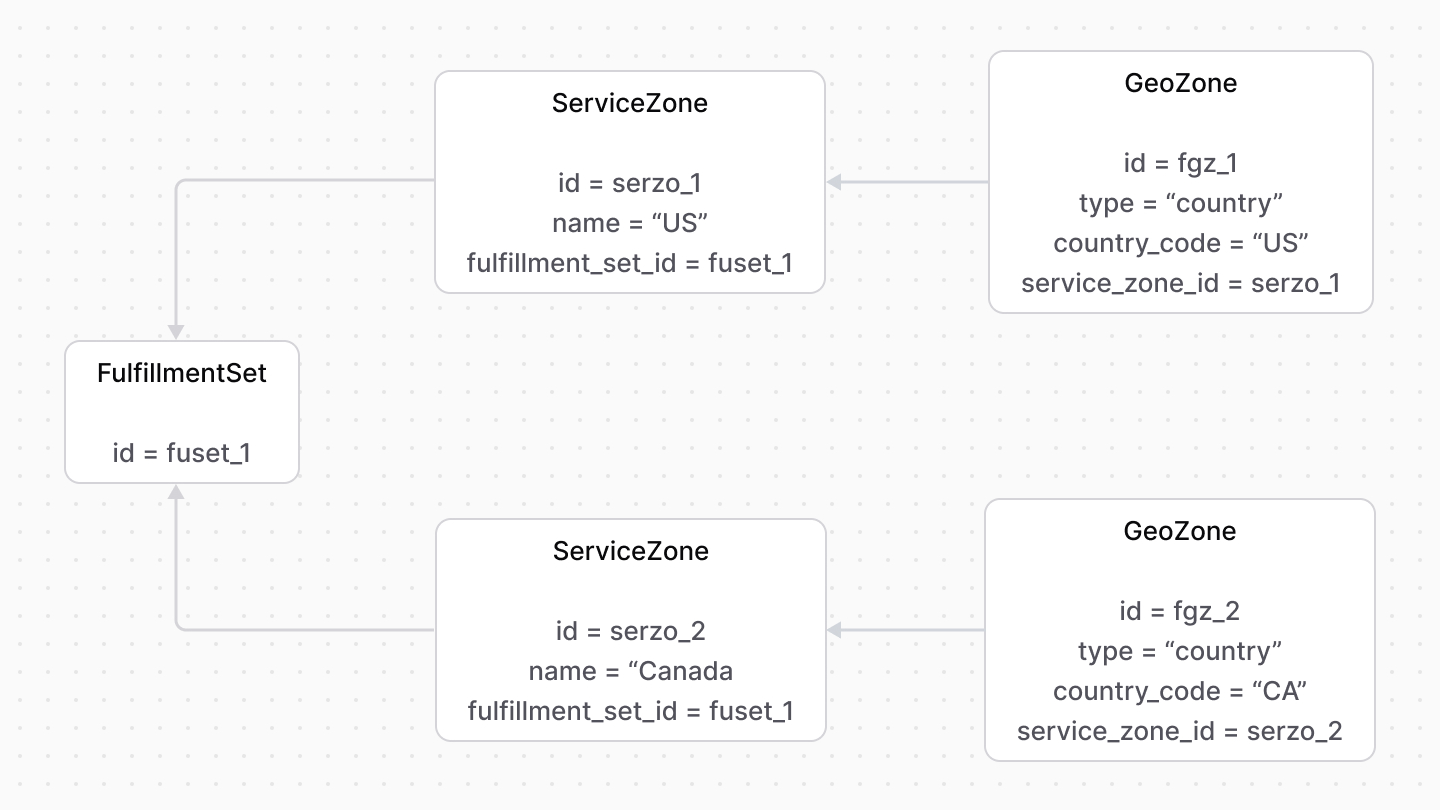
A service zone is a collection of geographical zones or areas. It’s used to restrict available shipping options to a defined set of locations.
|
||
|
||
A service zone is represented by the [ServiceZone data model](/references/fulfillment/models/ServiceZone). It’s associated with a fulfillment set, as each service zone is specific to a form of fulfillment. For example, if a customer chooses to pick up items, you can restrict the available shipping options based on their location.
|
||
|
||
|
||
|
||
A service zone can have multiple geographical zones, each represented by the [GeoZone data model](/references/fulfillment/models/GeoZone). It holds location-related details to narrow down supported areas, such as country, city, or province code.
|
||
|
||
<Note title="Tip">
|
||
|
||
The province code is always in lower-case and in [ISO 3166-2 format](https://en.wikipedia.org/wiki/ISO_3166-2).
|
||
|
||
</Note>
|
||
|
||
---
|
||
|
||
## Shipping Profile
|
||
|
||
A shipping profile defines a type of items that are shipped in a similar manner. For example, a `default` shipping profile is used for all item types, but the `digital` shipping profile is used for digital items that aren’t shipped and delivered conventionally.
|
||
|
||
A shipping profile is represented by the [ShippingProfile data model](/references/fulfillment/models/ShippingProfile). It only defines the profile’s details, but it’s associated with the shipping options available for the item type.
|