 fa7c94b4cc
* docs: migrate ui docs to docs universe

* created yarn workspace

* added eslint and tsconfig configurations

* fix eslint configurations

* fixed eslint configurations

* shared tailwind configurations

* added shared ui package

* added more shared components

* migrating more components

* made details components shared

* move InlineCode component

* moved InputText

* moved Loading component

* Moved Modal component

* moved Select components

* Moved Tooltip component

* moved Search components

* moved ColorMode provider

* Moved Notification components and providers

* used icons package

* use UI colors in api-reference

* moved Navbar component

* used Navbar and Search in UI docs

* added Feedback to UI docs

* general enhancements

* fix color mode

* added copy colors file from ui-preset

* added features and enhancements to UI docs

* move Sidebar component and provider

* general fixes and preparations for deployment

* update docusaurus version

* adjusted versions

* fix output directory

* remove rootDirectory property

* fix yarn.lock

* moved code component

* added vale for all docs MD and MDX

* fix tests

* fix vale error

* fix deployment errors

* change ignore commands

* add output directory

* fix docs test

* general fixes

* content fixes

* fix announcement script

* added changeset

* fix vale checks

* added nofilter option

* fix vale error
2.9 KiB
description
| description |
|---|
| Learn about Medusa's architecture and get a general overview of how all different tools work together. |
Medusa Architecture Overview
In this document, you'll get an overview of Medusa's architecture to better understand how all resources and tools work together.
Architecture Overview
Medusa's core package @medusajs/medusa is a Node.js backend built on top of Express. It combines all the Commerce Modules that Medusa provides. Commerce Modules are ecommerce features that can be used as building blocks in an ecommerce ecosystem. Product is an example of a Commerce Module.
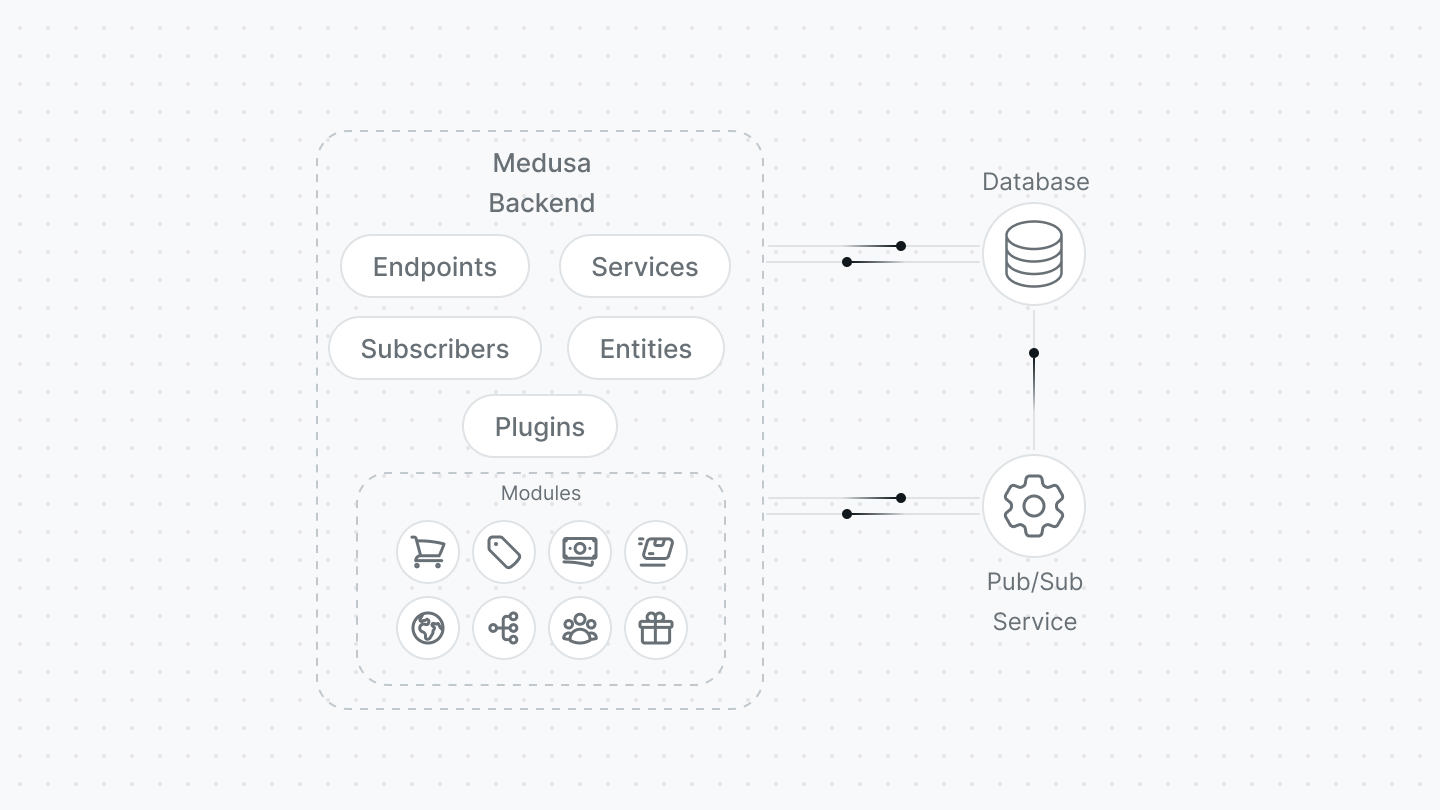
The backend connects to a database, such as PostgreSQL, to store the ecommerce store’s data. The tables in that database are represented by Entities, built on top of Typeorm. Entities can also be reflected in the database using Migrations.
The retrieval, manipulation, and other utility methods related to that entity are created inside a Service. Services are TypeScript or JavaScript classes that, along with other resources, can be accessed throughout the Medusa backend through dependency injection.
The backend does not have any tightly-coupled frontend. Instead, it exposes Endpoints which are REST APIs that frontends such as an admin or a storefront can use to communicate with the backend. Endpoints are Express routes.
Medusa also uses an Events Architecture to trigger and handle events. Events are triggered when a specific action occurs, such as when an order is placed. To manage this events system, Medusa connects to a service that implements a pub/sub model, such as Redis.
Events can be handled using Subscribers. Subscribers are TypeScript or JavaScript classes that add their methods as handlers for specific events. These handler methods are only executed when an event is triggered.
You can create any of the resources in the backend’s architecture, such as entities, endpoints, services, and more, as part of your custom development without directly modifying the backend itself. The Medusa backend uses loaders to load the backend’s resources, as well as your custom resources and resources in Plugins.
You can package your customizations into Plugins to reuse them in different Medusa backends or publish them for others to use. You can also install existing plugins into your Medusa backend.