
119 lines
3.7 KiB
Plaintext
119 lines
3.7 KiB
Plaintext
import { Table } from "docs-ui"
|
||
|
||
export const metadata = {
|
||
title: `Promotion Concepts`,
|
||
}
|
||
|
||
# {metadata.title}
|
||
|
||
In this document, you’ll learn about the main promotion and rule concepts in the Promotion Module.
|
||
|
||
<Note title="Looking for no-code docs?">
|
||
|
||
Refer to this [Medusa Admin User Guide](!user-guide!/promotions) to learn how to manage promotions using the dashboard.
|
||
|
||
</Note>
|
||
|
||
## What is a Promotion?
|
||
|
||
A promotion, represented by the [Promotion data model](/references/promotion/models/Promotion), is a discount that can be applied on cart items, shipping methods, or entire orders.
|
||
|
||
A promotion has two types:
|
||
|
||
- `standard`: A standard promotion with rules.
|
||
- `buyget`: “A buy X get Y” promotion with rules.
|
||
|
||
<Table>
|
||
<Table.Header>
|
||
<Table.Row>
|
||
<Table.HeaderCell>
|
||
|
||
`standard` Promotion Examples
|
||
|
||
</Table.HeaderCell>
|
||
<Table.HeaderCell>
|
||
|
||
`buyget` Promotion Examples
|
||
|
||
</Table.HeaderCell>
|
||
</Table.Row>
|
||
</Table.Header>
|
||
<Table.Body>
|
||
<Table.Row>
|
||
<Table.Cell>
|
||
|
||
A coupon code that gives customers 10% off their entire order.
|
||
|
||
</Table.Cell>
|
||
<Table.Cell>
|
||
|
||
Buy two shirts and get another for free.
|
||
|
||
</Table.Cell>
|
||
</Table.Row>
|
||
<Table.Row>
|
||
<Table.Cell>
|
||
|
||
A coupon code that gives customers $15 off any shirt in their order.
|
||
|
||
</Table.Cell>
|
||
<Table.Cell>
|
||
|
||
Buy two shirts and get 10% off the entire order.
|
||
|
||
</Table.Cell>
|
||
</Table.Row>
|
||
<Table.Row>
|
||
<Table.Cell>
|
||
|
||
A discount applied automatically for VIP customers that removes 10% off their shipping method’s amount.
|
||
|
||
</Table.Cell>
|
||
<Table.Cell>
|
||
|
||
Spend $100 and get free shipping.
|
||
|
||
</Table.Cell>
|
||
</Table.Row>
|
||
</Table.Body>
|
||
</Table>
|
||
|
||
<Note>
|
||
|
||
The Medusa Admin UI may not provide a way to create each of these promotion examples. However, they are supported by the Promotion Module and Medusa's workflows and API routes.
|
||
|
||
</Note>
|
||
|
||
---
|
||
|
||
## PromotionRule
|
||
|
||
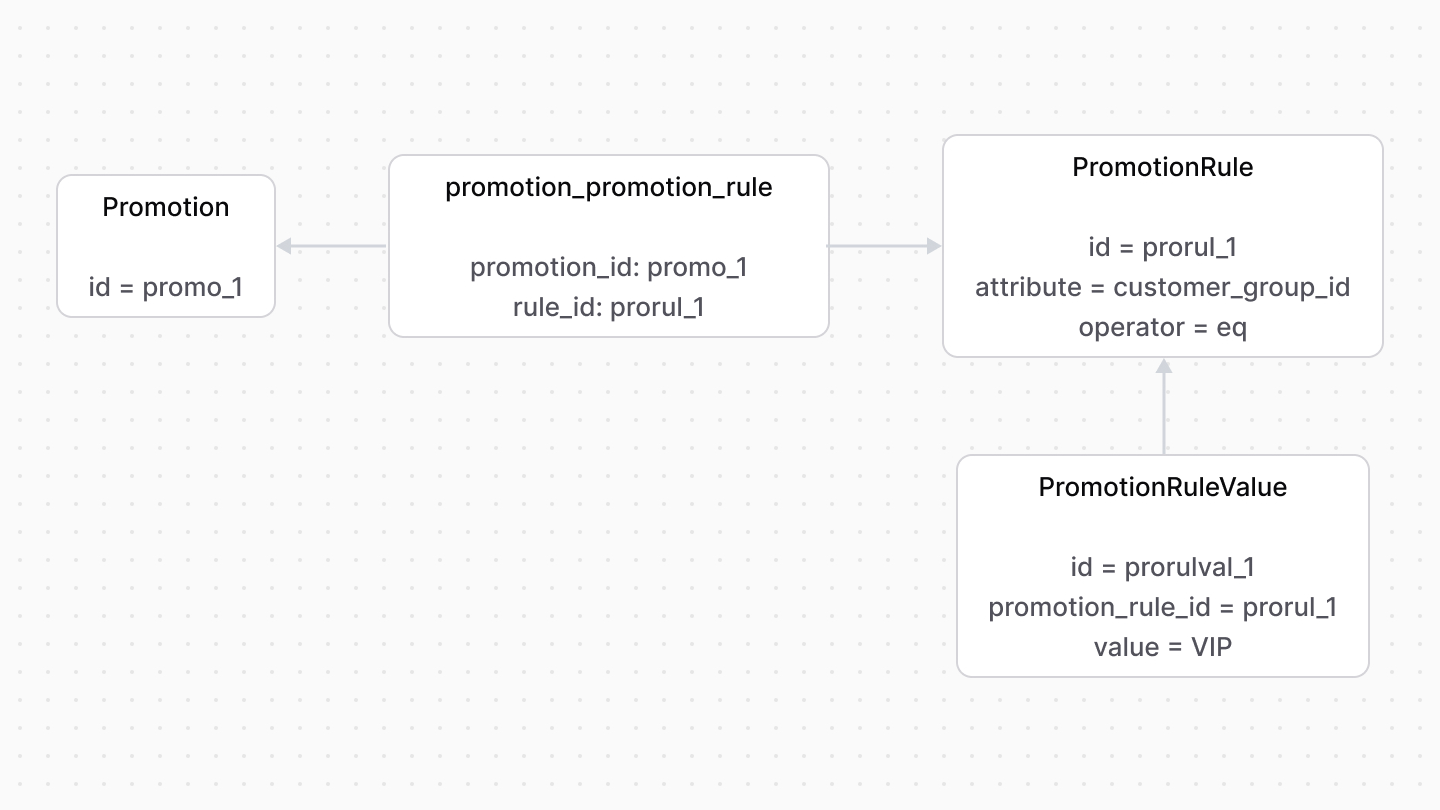
A promotion can be restricted by a set of rules, each rule is represented by the [PromotionRule data model](/references/promotion/models/PromotionRule).
|
||
|
||
For example, you can create a promotion that only customers of the `VIP` customer group can use.
|
||
|
||
|
||
|
||
A `PromotionRule`'s `attribute` property indicates the property's name to which this rule is applied.
|
||
|
||
For example, `customer_group_id`. Its value is stored in the `PromotionRuleValue` data model. So, a rule can have multiple values.
|
||
|
||
When testing whether a promotion can be applied to a cart, the rule's `attribute` property and its values are tested on the cart itself.
|
||
|
||
For example, the cart's customer must be part of the customer group(s) indicated in the promotion rule's value.
|
||
|
||
---
|
||
|
||
## Flexible Rules
|
||
|
||
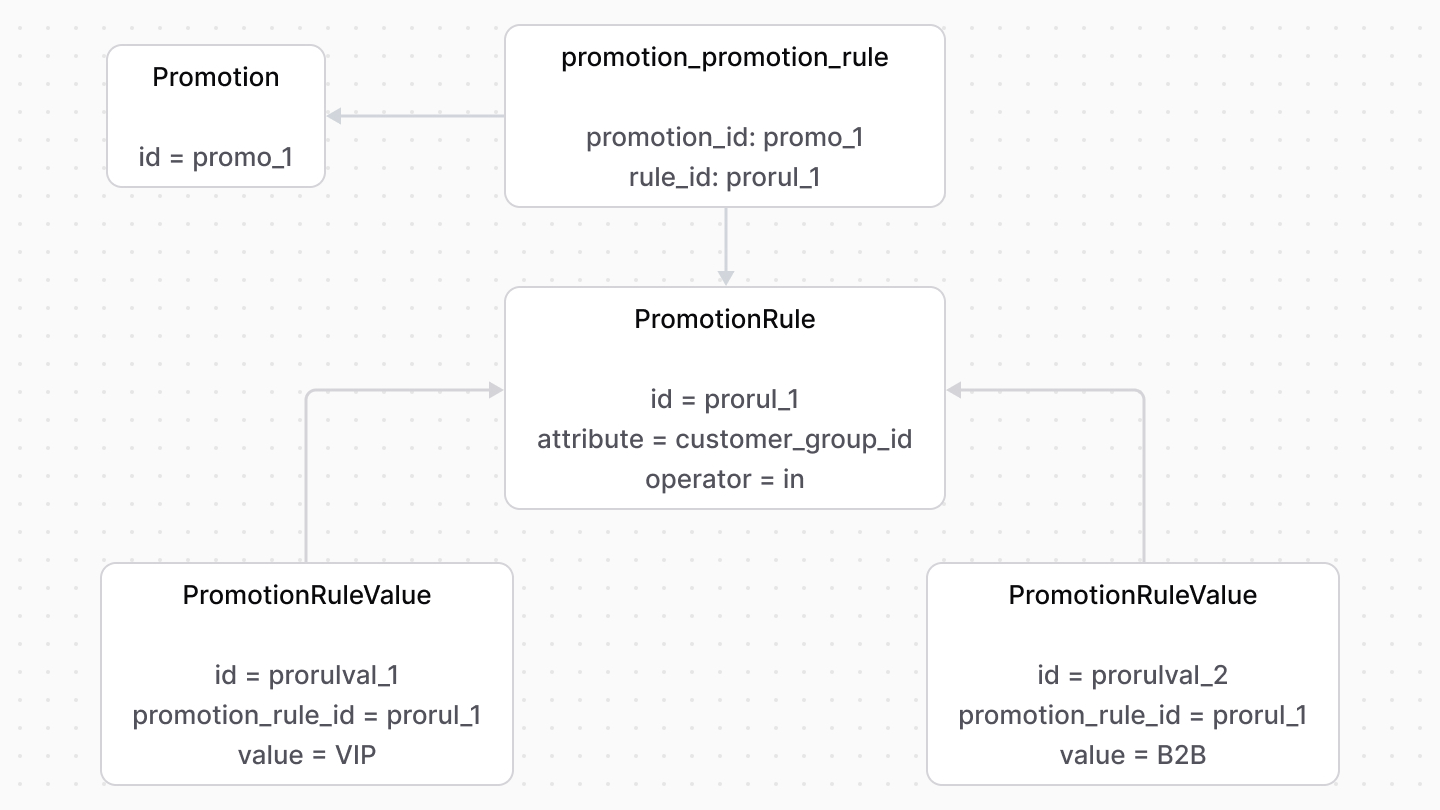
The `PromotionRule`'s `operator` property adds more flexibility to the rule’s condition rather than simple equality (`eq`).
|
||
|
||
For example, to restrict the promotion to only `VIP` and `B2B` customer groups:
|
||
|
||
- Add a `PromotionRule` record with its `attribute` property set to `customer_group_id` and `operator` property to `in`.
|
||
- Add two `PromotionRuleValue` records associated with the rule: one with the value `VIP` and the other `B2B`.
|
||
|
||
|
||
|
||
In this case, a customer’s group must be in the `VIP` and `B2B` set of values to use the promotion.
|