**What**
- enable to filter sales channels of a Publishable API Key with a free text search param

Co-authored-by: Oliver Windall Juhl <59018053+olivermrbl@users.noreply.github.com>
### What

Explicitly declare `@medusajs/medusa` as a devDependency for `@medusajs/medusa-js` client package.

### Why

With our latest version upgrade of `turbo`, peerDependencies aren't taken into account in the build graph. The recommendation is to also explicitly declare them in devDependencies.

### Test

* Run `yarn build --graph`
* Expect to see medusa-js having a dependency on medusa
```
"[root] @medusajs/medusa-js#build" -> "[root] @medusajs/medusa#build"
```
### What

Flip Turborepo cache glob pattern from an allow-list to deny-list pattern.

### Why

Packages within medusa's monorepo will output their build to a `dist` directory.

This convention does not apply to plugins since the core plugin loader expects the content of plugin packages `src` directory to be outputted at the root of the package.

i.e. `packages/foobar-plugin/src/utils/index.ts` -> `packages/foobar-plugin/utils/index.js`

Manually maintaining an allow-list of known plugin output directories is not scalable. When a directory exists in a plugin package but is not know to the allow-list, the directory will not be re-built on subsequent builds. Troubleshooting the issue requires intimate knowledge of Turborepo caching strategies.

### How

By using a deny-list glob pattern, plugin packages can now declare any not-known directory within their `src` folder without facing any potential omission issues during the build process.

We declare `src` and its content as the only directory for turbo cache to ignore.

### Additional scope

* Use `turbo.json` file content in cache hashing algorithm in order to break CI cache when changes are made to the Turborepo config.
* Upgraded turbo minor verion.
* Added missing dependency to medusa package.

### Test
* Delete previously built output in packages. Run `yarn build --force` (replace any existing cache)
  * Expect all src content to be outputted
* Run `yarn build` right after
  * Expect a fast build time since cache will be fresh
* Add a new directory with an index.ts file in a plugin package src folder. Run `yarn build`
  * Expect a fast build time, except for the modified plugin package.
  * Expect the newly added directory to be outputted.
* Delete the newly outputted directory. Run `yarn build`
  * Expect the outputted directory to reappear.

### References
* https://github.com/medusajs/medusa/blob/5093b82f3a28323e99b6b133ae87c76fac01a298/packages/medusa/src/loaders/plugins.ts
* https://turbo.build/repo/docs/reference/configuration#outputs
* https://turbo.build/repo/docs/reference/configuration#globaldependencies

Resolves CORE-891
**What**

When a discount is deleted from a cart, the line item adjustments must be refreshed. Now, the cart service `removeDiscount` includes updating the adjustments.

**Tests**

**Add a new integration test which:**
- create a cart with a discount
- add a line item
- validate the adjustments
- remove the discount
- check that the adjustments are not present anymore

**Update unit tests**
The actual tests cases now check that the adjustments repository is called when needed

FIXES CORE-890
### What
Leverage yarn workspaces and Turborepo for integration-tests in order to accelerate development and reduce DevX complexity.

### Why
The current solution for running integration tests requires using `medusa-dev-cli` in order to publish packages to a local npm repository. The package where the command is executed will have its package.json altered for any known medusa dependency in order to install from the local npm. The process is taxing on the host machine resources and prevents rapid iterations when working with integration tests.

For more information, see documentation: https://github.com/medusajs/medusa/blob/f0cc1b324c964680c26e0d5c1d45769cbd750176/docs/content/usage/local-development.md#run-api-integration-tests

### How
By declaring `integeration-tests/**/*` as a workspace, Turborepo can now be leveraged to build and run integration test as if there were packages. The build process will take care of interdependency between package in order to ensure local dependency are met.

In addition, within each integration-tests "packages", we can declare local dependencies as "*" which will translate to using the one that is part of the current build, regardless of the dependency's version number. No more fiddling with version numbers.

Github actions pertaining to integration-tests have been streamlined to use the new behavior.

The integration-tests packages have been marked as `private:true` in order to avoid publishing them to the public npm registry.

### Testing
```
cd root-of-medusajs-medusa-repo/
yarn install
yarn build
yarn test:integration:api
yarn test:integration:plugins
```

After a code change, `yarn build` must be run before re-running an integration test, which is the same procedure as for unit tests.

Resolves: CORE-845
**What**

I have created a new method on the cart service which is `addLineItems`, allowing a user to add one or multiple items in an optimized way. Also updated the `generate` method from the line item service which now also accept a object data or a collection of data which. Various places have been optimized and cache support has been added to the price selection strategy.

The overall optimization allows to reach another 9000% improvement in the response time as a median (Creating a cart with 6 items):

|   | Min (ms)  | Median (ms)  | Max (ms)  | Median Improvement (%)
|---|:-:|---|---|---|
| Before optimisation  | 1200  | 9999 | 12698  |  N/A
| After optimisation | 63  | 252  | 500  | 39x
| After re optimisation | 56 | 82  | 399  | 121x
| After including addressed feedback | 65 | 202  | 495  | 49x

FIXES CORE-722
### What
OAS: Explicitly declare type:object on schemas with properties.
### Why
While not officially required, schemas with properties should have their type explicitly declared as "object". Omitting the type translates to type: any with properties XYZ. The ambiguity can lead to issues when using code generators.
### How
Multiple regex searches to identify schemas missing type: object. Manually edit each schema. Spot check generated OAS.
### Testing
- Ran OAS validator.
- Ran docs build script
### Proof
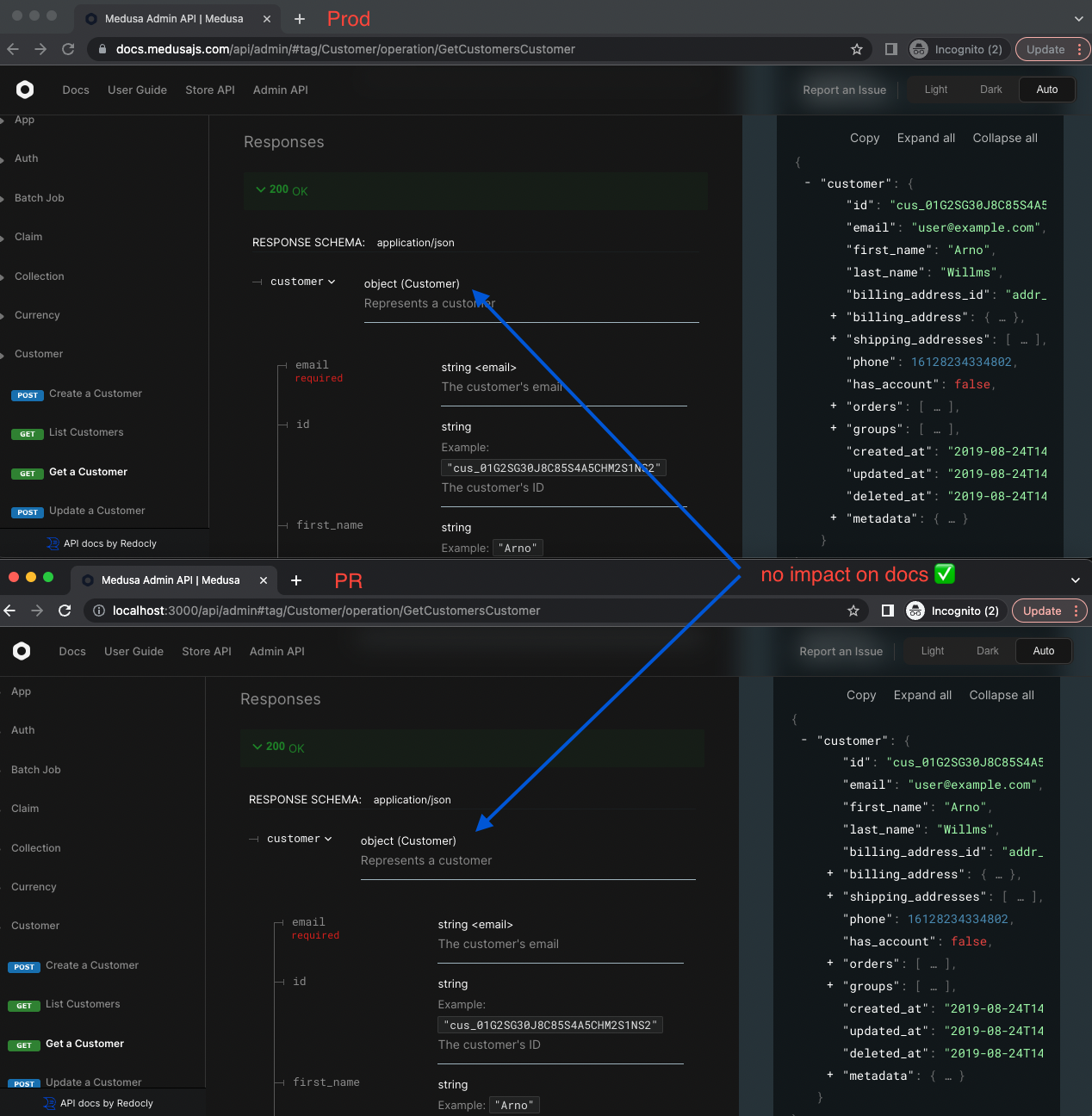
RESOLVES CORE-847
**What**

Allow DraftOrders to be created with an IdempotencyKey.

Note this doesn't implement idempotency for the DraftOrder create endpoint but allows the service layer to ingest the key and store it in the database. This is a preliminary step to being able to support an idempotent API request.
* use correct authentication middleware

* remove guard from get-session since it's guarded by middleware doing the same check

* Add integration tests

* Create lazy-swans-agree.md

Co-authored-by: olivermrbl <oliver@mrbltech.com>
Co-authored-by: Oliver Windall Juhl <59018053+olivermrbl@users.noreply.github.com>
**What**
Fix system error (500) with DraftOrder create operation when payload includes discount in a tax-inclusive context.

**How**
* Ensure newly created cart contains all required relation in order to calculate line item tax-inclusive pricing with discounts.
* Add resilience to TotalsService.getLineDiscounts()
* Ensure newly generate line items have variant relation loaded.
* fix TotalsService.getLineItemTotals to use the passed lineItem instead of relying on cartOrOrder.items.

**Test**
* Unit:
  *  TotalsService.getLineDiscounts - coverage
* Integration:
  * Admin API draft-order - coverage
  * Admin API draft-order create w/ discount in tax-inclusive

Resolves: CORE-771

Co-authored-by: Oliver Windall Juhl <59018053+olivermrbl@users.noreply.github.com>
Co-authored-by: Adrien de Peretti <25098370+adrien2p@users.noreply.github.com>
 Kasper Fabricius Kristensen
 Adrien de Peretti
 Philip Korsholm

 Frane PolićandOliver Windall Juhl
 Patrick
 olivermrbl
 Riqwan Thamir
 Sebastian Rindom