
59 lines
2.9 KiB
Plaintext
59 lines
2.9 KiB
Plaintext
export const metadata = {
|
||
title: `Payment Webhook Events`,
|
||
}
|
||
|
||
# {metadata.title}
|
||
|
||
In this guide, you’ll learn how you can handle payment webhook events in your Medusa application and using the Payment Module.
|
||
|
||
## What's a Payment Webhook Event?
|
||
|
||
A payment webhook event is a request sent from a third-party payment provider to your application. It indicates a change in a payment’s status.
|
||
|
||
This is useful in many cases such as:
|
||
|
||
- When a payment is processed (authorized or captured) asynchronously.
|
||
- When a payment is managed on the third-party payment provider's side.
|
||
- When a payment action on the frontend was interrupted, leading the payment to be processed without an order being created in the Medusa application.
|
||
|
||
So, it's essential to handle webhook events to ensure that your application is aware of updated payment statuses and can take appropriate actions.
|
||
|
||
---
|
||
|
||
## How to Handle Payment Webhook Events
|
||
|
||
### Webhook Listener API Route
|
||
|
||
The Medusa application has a `/hooks/payment/[identifier]_[provider]` API route out-of-the-box that allows you to listen to webhook events from third-party payment providers, where:
|
||
|
||
- `[identifier]` is the `identifier` static property defined in the payment provider. For example, `stripe`.
|
||
- `[provider]` is the ID of the provider. For example, `stripe`.
|
||
|
||
For example, when integrating basic Stripe payments with the [Stripe Module Provider](../payment-provider/stripe/page.mdx), the webhook listener route is `/hooks/payment/stripe_stripe`.
|
||
|
||
You can use this webhook listener when configuring webhook events in your third-party payment provider.
|
||
|
||
### getWebhookActionAndData Method
|
||
|
||
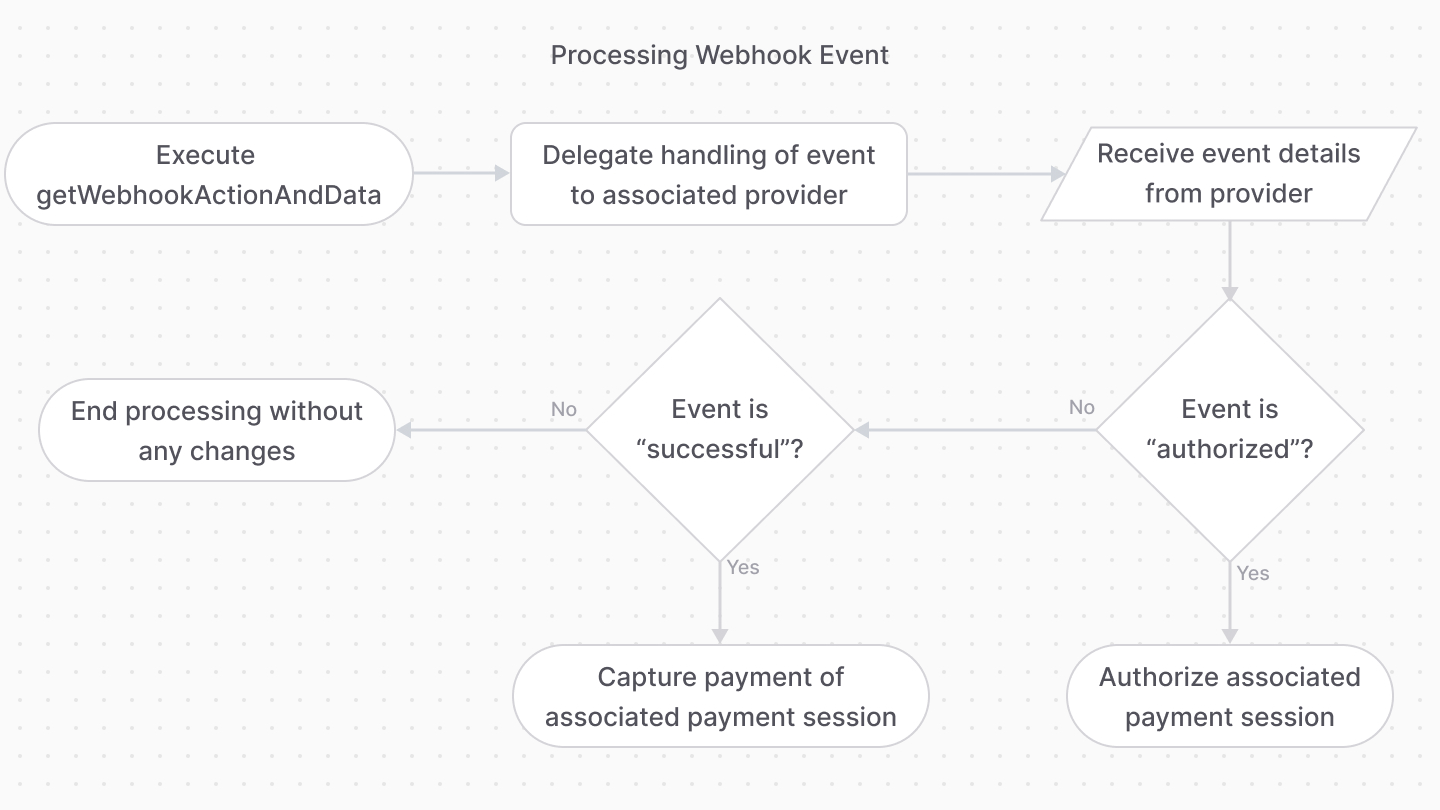
The webhook listener API route executes the [getWebhookActionAndData method](/references/payment/getWebhookActionAndData) of the Payment Module's main service. This method delegates handling of incoming webhook events to the relevant payment provider.
|
||
|
||
<Note title="Tip">
|
||
|
||
Payment providers have a similar [getWebhookActionAndData method](/references/payment/provider) to process the webhook event. So, if you're implementing a custom payment provider, make sure to implement it to handle webhook events.
|
||
|
||
</Note>
|
||
|
||
|
||
|
||
If the `getWebhookActionAndData` method returns an `authorized` or `captured` action, the Medusa application will perform one of the following actions:
|
||
|
||
<Note>
|
||
|
||
View the full flow of the webhook event processing in the [processPaymentWorkflow](/references/medusa-workflows/processPaymentWorkflow) reference.
|
||
|
||
</Note>
|
||
|
||
- If the method returns an `authorized` action, Medusa will set the associated payment session to `authorized`.
|
||
- If the method returns a `captured` action, Medusa will set the associated payment session to `captured`.
|
||
- In either cases, if the cart associated with the payment session is not completed yet, Medusa will complete the cart.
|